Read from Aerospike
Read From Aerospike Using Spark via Map Transformation in Spark
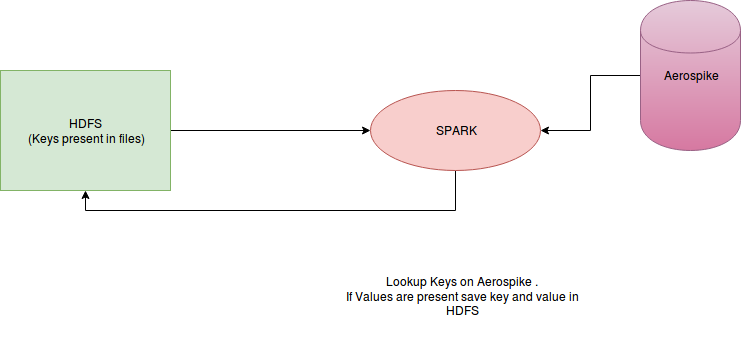
Problem Statement : We have keys saved in file present on HDFS and for the given keys one has to lookup values from Aerospike , and save it back on HDFS.
<dependencies>
    <dependency>
        <groupId>org.apache.spark</groupId>
        <artifactId>spark-sql_2.10</artifactId>
        <version>1.6.0-cdh5.9.0</version>
    </dependency>
    <dependency>
        <groupId>org.apache.spark</groupId>
        <artifactId>spark-core_2.10</artifactId>
        <version>1.6.0-cdh5.9.0</version>
    </dependency>
    <dependency>
        <groupId>com.big.data</groupId>
        <artifactId>avro-schema</artifactId>
        <version>${project.version}</version>
    </dependency>
    <dependency>
        <groupId>com.databricks</groupId>
        <artifactId>spark-avro_2.10</artifactId>
        <version>3.0.0</version>
    </dependency>
    <dependency>
        <groupId>com.twitter</groupId>
        <artifactId>parquet-avro</artifactId>
        <version>1.5.0-cdh5.9.0</version>
    </dependency>
    <dependency>
        <groupId>com.googlecode.json-simple</groupId>
        <artifactId>json-simple</artifactId>
        <version>1.1.1</version>
    </dependency>
    <dependency>
        <groupId>com.databricks</groupId>
        <artifactId>spark-csv_2.10</artifactId>
        <version>1.5.0</version>
        <scope>compile</scope>
    </dependency>
    <dependency>
        <groupId>com.aerospike</groupId>
        <artifactId>aerospike-client</artifactId>
        <version>3.2.2</version>
    </dependency>
    <dependency>
        <groupId>com.aerospike.unit</groupId>
        <artifactId>aerospike-unit</artifactId>
        <version>1.0.0-SNAPSHOT</version>
    </dependency>
</dependencies>
package com.big.data.spark;

import com.aerospike.client.AerospikeClient;
import com.aerospike.client.Key;
import com.aerospike.client.Record;
import com.aerospike.client.policy.WritePolicy;
import com.big.data.avro.schema.Employee;
import com.databricks.spark.avro.SchemaConverters;
import org.apache.avro.Schema;
import org.apache.commons.io.IOUtils;
import org.apache.hadoop.conf.Configuration;
import org.apache.hadoop.conf.Configured;
import org.apache.hadoop.util.Tool;
import org.apache.hadoop.util.ToolRunner;
import org.apache.spark.SparkConf;
import org.apache.spark.api.java.JavaRDD;
import org.apache.spark.api.java.JavaSparkContext;
import org.apache.spark.api.java.function.Function;
import org.apache.spark.sql.DataFrame;
import org.apache.spark.sql.Row;
import org.apache.spark.sql.RowFactory;
import org.apache.spark.sql.SQLContext;
import org.apache.spark.sql.types.Metadata;
import org.apache.spark.sql.types.StructField;
import org.apache.spark.sql.types.StructType;

import java.io.Closeable;
import java.io.IOException;

import static org.apache.spark.sql.types.DataTypes.StringType;


public class ReadKeysFromHdfsgetValuesfromAerospikeSpark
                             extends Configured implements Tool, Closeable {

    public static final String INPUT_PATH = "spark.input.path";
    public static final String OUTPUT_PATH = "spark.output.path";
    public static final String IS_RUN_LOCALLY = "spark.is.run.local";
    public static final String DEFAULT_FS = "spark.default.fs";
    public static final String NUM_PARTITIONS = "spark.num.partitions";

    //Aerospike related properties
    public static final String AEROSPIKE_HOSTNAME = "aerospike.host.name";
    public static final String AEROSPIKE_PORT = "aerospike.port";
    public static final String AEROSPIKE_NAMESPACE = "aerospike.name.space";
    public static final String AEROSPIKE_SETNAME = "aerospike.set.name";

    // For Dem key is emp_id and value is emp_name
    public static final String KEY_NAME = "avro.key.name";
    public static final String VALUE_NAME = "avro.value.name";

    public static final String EMPLOYEE_COUNTRY_KEY_NAME = "emp_country";

    private SQLContext sqlContext;
    private JavaSparkContext javaSparkContext;

    protected <T> JavaSparkContext getJavaSparkContext(final boolean isRunLocal,
                                                       final String defaultFs,
                                                       final Class<T> tClass) {
        final SparkConf sparkConf = new SparkConf()
                //Set spark conf here ,
                //after one gets spark context you can set hadoop configuration for InputFormats
                .setAppName(tClass.getSimpleName())
                .set("spark.serializer", "org.apache.spark.serializer.KryoSerializer");

        if (isRunLocal) {
            sparkConf.setMaster("local[*]");
        }

        final JavaSparkContext sparkContext = new JavaSparkContext(sparkConf);

        if (defaultFs != null) {
            sparkContext.hadoopConfiguration().set("fs.defaultFS", defaultFs);
        }

        return sparkContext;
    }

    @Override
    public int run(String[] args) throws Exception {

        //The arguments passed has been split into Key value by ToolRunner
        Configuration conf = getConf();
        String inputPath = conf.get(INPUT_PATH);
        String outputPath = conf.get(OUTPUT_PATH);
        String aerospikeHostname = conf.get(AEROSPIKE_HOSTNAME);
        int aerospikePort = conf.getInt(AEROSPIKE_PORT, 3000);
        String namespace = conf.get(AEROSPIKE_NAMESPACE);
        String setName = conf.get(AEROSPIKE_SETNAME);

        String valueName = conf.get(VALUE_NAME);

        //Get spark context, This is the central context ,
        //which can be wrapped in Any Other context
        javaSparkContext = getJavaSparkContext(conf.getBoolean(IS_RUN_LOCALLY, Boolean.FALSE),
                                                            conf.get(DEFAULT_FS), this.getClass());
        sqlContext = new SQLContext(javaSparkContext);

        // No input path has been read, no job has not been started yet .
        //To set any configuration use javaSparkContext.hadoopConfiguration().set(Key,value);
        // To set any custom inputformat use javaSparkContext.newAPIHadoopFile() and get a RDD

        // Avro schema to StructType conversion
        final StructType outPutSchemaStructType = (StructType) SchemaConverters
                                                     .toSqlType(Employee.getClassSchema()).dataType();

        final StructType inputSchema = new StructType(
               new StructField[]{new StructField("emp_id", StringType, false, Metadata.empty())});

        // read data from parquetfile, the schema of the data is taken from the avro schema
        DataFrame inputDf = sqlContext.read().schema(inputSchema).text(inputPath);

        // convert DataFrame into JavaRDD
        // the rows read from the parquetfile is converted into a Row object .
        //  Row has same schema as that of the parquet file roe
        JavaRDD<Row> rowJavaRDD = inputDf.javaRDD();

        // Data read from parquet has same schema as that of avro (Empoyee Avro).
        // Key is employeeId and value is EmployeeName
        // In the map there is no special function to initialize or shutdown the Aerospike client.
        JavaRDD<Row> returnedRowJavaRDD = rowJavaRDD.map
              (new InsertIntoAerospike(aerospikeHostname, aerospikePort, namespace,
                                                         setName, "emp_id",valueName));

        //Map is just a transformation in Spark hence a action
        //like write(), collect() is needed to carry out the action.
        // Remeber spark does Lazy evaluation, without a action transformations will not execute.

        DataFrame outputDf = sqlContext.createDataFrame(returnedRowJavaRDD, outPutSchemaStructType);

        // Convert JavaRDD to dataframe and save into parquet file
        outputDf
                .write()
                .format(Employee.class.getCanonicalName())
                .parquet(outputPath);

        return 0;
    }

    // Do remember all the lambda function are instantiated on driver, serialized and sent to driver.
    // No need to initialize the Service(Aerospike , Hbase on driver ) hence making it transiet
    // In the map , for each record insert into Aerospike , this can be coverted into batch too
    public static class InsertIntoAerospike implements Function<Row, Row> {

        // not making it static , as it will not be serialized and sent to executors
        private final String aerospikeHostName;
        private final int aerospikePortNo;
        private final String aerospikeNamespace;
        private final String aerospikeSetName;
        private final String keyColumnName;
        private final String valueColumnName;

        // The Aerospike client is not serializable
        // and neither there is a need to instatiate on driver
        private transient AerospikeClient client;
        private transient WritePolicy policy;

        public InsertIntoAerospike(String hostName, int portNo,
             String nameSpace, String setName, String keyColumnName, String valueColumnName) {
            this.aerospikeHostName = hostName;
            this.aerospikePortNo = portNo;
            this.aerospikeNamespace = nameSpace;
            this.aerospikeSetName = setName;
            this.keyColumnName = keyColumnName;
            this.valueColumnName = valueColumnName;

            //Add Shutdown hook to close the client gracefully
            //This is the place where u can gracefully clean your Service resources
            //As there is no cleanup() function in Spark Map
            JVMShutdownHook jvmShutdownHook = new JVMShutdownHook();
            Runtime.getRuntime().addShutdownHook(jvmShutdownHook);

        }

        @Override
        public Row call(Row row) throws Exception {
            // Intitialize on the first call
            if (client == null) {
                policy = new WritePolicy();
                // how to close the client gracefully ?
                client = new AerospikeClient(aerospikeHostName, aerospikePortNo);
            }

            String empID = (String) row.get(row.fieldIndex(keyColumnName));

            // As rows have schema with fieldName and Values being part of the Row
            Key key = new Key(aerospikeNamespace, aerospikeSetName, Integer.parseInt(empID));

            //Get from Aerospike  for a given employee id the employeeName
            Record result1 = client.get(policy, key);
            Employee employee = new Employee();
            employee.setEmpId(Integer.valueOf(empID));
            employee.setEmpName(result1.getValue(valueColumnName).toString());

            // This by default is available for Every key present in Aerospike
            employee.setEmpCountry(result1.getValue(EMPLOYEE_COUNTRY_KEY_NAME).toString());

            // creation of Employee object could have been skipped its just to make things clear
            // Convert Employee Avro To Object[]
            Object[] outputArray = new Object[Employee.getClassSchema().getFields().size()];
            for (Schema.Field field : Employee.getClassSchema().getFields()) {
                outputArray[field.pos()] = employee.get(field.pos());

            }

            return RowFactory.create(outputArray);

        }

        //When JVM is going down close the client
        private class JVMShutdownHook extends Thread {
            @Override
            public void run() {
                System.out.println("JVM Shutdown Hook: Thread initiated ,
                                               shutting down service gracefully");
                IOUtils.closeQuietly(client);
            }
        }
    }

    @Override
    public void close() throws IOException {
        IOUtils.closeQuietly(javaSparkContext);
    }

    public static void main(String[] args) throws Exception {
        ToolRunner.run(new ReadKeysFromHdfsgetValuesfromAerospikeSpark(), args);
    }

}
[addToAppearHere]
Aerospike Unit Test framework:
Integration Test:
package com.big.data.spark;

import com.aerospike.client.AerospikeClient;
import com.aerospike.client.Bin;
import com.aerospike.client.Key;
import com.aerospike.client.policy.WritePolicy;
import com.aerospike.unit.impls.AerospikeRunTimeConfig;
import com.aerospike.unit.impls.AerospikeSingleNodeCluster;
import com.aerospike.unit.utils.AerospikeUtils;
import com.big.data.avro.AvroUtils;
import com.big.data.avro.schema.Employee;
import org.apache.avro.generic.GenericData;
import org.apache.avro.generic.GenericRecord;
import org.apache.commons.io.FileUtils;
import org.apache.hadoop.conf.Configuration;
import org.apache.hadoop.fs.FSDataOutputStream;
import org.apache.hadoop.fs.FileSystem;
import org.apache.hadoop.fs.Path;
import org.junit.After;
import org.junit.Assert;
import org.junit.Before;
import org.junit.Test;
import org.slf4j.Logger;
import org.slf4j.LoggerFactory;
import parquet.avro.AvroParquetReader;
import parquet.hadoop.ParquetReader;

import java.io.File;


public class ReadKeysFromHdfsgetValuesfromAerospikeSparkTest {

    private static final Logger LOG = LoggerFactory.getLogger(ReadWriteAvroParquetFilesTest.class);
    private static final String BASEDIR =
        "/tmp/ReadKeysFromHdfsgetValuesfromAerospikeSparkTest/avroparquetInputFile/"
                               + System.currentTimeMillis() + "/";
    private String input;
    private String output;

    private AerospikeSingleNodeCluster cluster;
    private AerospikeRunTimeConfig runtimConfig;
    private AerospikeClient client;

    //Aerospike unit related Params
    private String memorySize = "64M";
    private String setName = "BIGTABLE";
    private String binName = "BIGBIN";
    private String nameSpace = "RandomNameSpace";

    @Before
    public void setUp() throws Exception {

        input = BASEDIR + "input/";
        output = BASEDIR + "output/";


        Configuration conf = new Configuration();
        conf.set("fs.default.fs","file:///");
        FileSystem fs =  FileSystem.get(conf);


        //Writing all the keys in Hdfs , input to the Job
        FSDataOutputStream out = fs.create(new Path(input, "part000"));
        out.write("1\n".getBytes());
        out.write("2\n".getBytes());
        //not exsistent key
        out.close();


        // Start Aerospike MiniCluster
        // Instatiate the cluster with NameSpaceName , memory Size.
        // One can use the default constructor and retieve nameSpace
        // ,Memory info from cluster.getRunTimeConfiguration();
        cluster = new AerospikeSingleNodeCluster(nameSpace, memorySize);
        cluster.start();
        // Get the runTime configuration of the cluster
        runtimConfig = cluster.getRunTimeConfiguration();
        client = new AerospikeClient("127.0.0.1", runtimConfig.getServicePort());
        AerospikeUtils.printNodes(client);


        // Insert Values in Aerospike for the appropriate keys

        //Fetch both the keys from Aerospike
        WritePolicy policy = new WritePolicy();
        Key key1 = new Key(runtimConfig.getNameSpaceName(), setName, 1);
        Bin bin1 = new Bin("emp_name", "Maverick1");
        Bin bin2 =
            new Bin(ReadKeysFromHdfsgetValuesfromAerospikeSpark.EMPLOYEE_COUNTRY_KEY_NAME, "DE");
        client.put(policy, key1,bin1,bin2);

        Key key2 = new Key(runtimConfig.getNameSpaceName(), setName, 2);
        Bin bin3 = new Bin("emp_name", "Maverick2");
        Bin bin4 =
             new Bin(ReadKeysFromHdfsgetValuesfromAerospikeSpark.EMPLOYEE_COUNTRY_KEY_NAME, "IND");

        client.put(policy, key2,bin3,bin4);


    }

    @Test
    public void testSuccess() throws Exception {

    String[] args = new String[]{
         "-D" + ReadWriteAvroParquetFiles.INPUT_PATH + "=" + input,
         "-D" + ReadKeysFromHdfsgetValuesfromAerospikeSpark.OUTPUT_PATH + "=" + output,
         "-D" + ReadKeysFromHdfsgetValuesfromAerospikeSpark.IS_RUN_LOCALLY + "=true",
         "-D" + ReadKeysFromHdfsgetValuesfromAerospikeSpark.DEFAULT_FS + "=file:///",
         "-D" + ReadKeysFromHdfsgetValuesfromAerospikeSpark.NUM_PARTITIONS + "=1",
         "-D" + ReadKeysFromHdfsgetValuesfromAerospikeSpark.AEROSPIKE_NAMESPACE + "="
                                                         + runtimConfig.getNameSpaceName(),
         "-D" + ReadKeysFromHdfsgetValuesfromAerospikeSpark.AEROSPIKE_HOSTNAME + "=127.0.0.1",
         "-D" + ReadKeysFromHdfsgetValuesfromAerospikeSpark.AEROSPIKE_PORT + "="
                                                         + runtimConfig.getServicePort(),
         "-D" + ReadKeysFromHdfsgetValuesfromAerospikeSpark.AEROSPIKE_SETNAME + "=" + setName,
         "-D" + ReadKeysFromHdfsgetValuesfromAerospikeSpark.KEY_NAME + "=emp_id",
         "-D" + ReadKeysFromHdfsgetValuesfromAerospikeSpark.VALUE_NAME + "=emp_name"};

        ReadKeysFromHdfsgetValuesfromAerospikeSpark.main(args);


        // Read from HDFS that the key and values are available
        ParquetReader<GenericRecord> reader = AvroParquetReader.builder(new Path(output)).build();
        //Use .withConf(FS.getConf())
        //for reading from a diferent HDFS and not local , by default the fs is local
        GenericData.Record event = null;
        while ((event = (GenericData.Record) reader.read()) != null) {
            Employee outputEvent = AvroUtils.convertByteArraytoAvroPojo(
                                        AvroUtils.convertAvroPOJOtoByteArray(event,
                                           Employee.getClassSchema()), Employee.getClassSchema());
            LOG.info("Data read from Sparkoutput is {}", outputEvent.toString());
            Assert.assertTrue(outputEvent.getEmpId().equals(1) || outputEvent.getEmpId().equals(2));
            Assert.assertTrue
       (outputEvent.getEmpName().equals("Maverick1") || outputEvent.getEmpName().equals("Maverick2"));
        }
        reader.close();

    }

    @After
    public void cleanup() throws Exception {
        FileUtils.deleteDirectory(new File(BASEDIR));

        if (cluster != null) {
            // Stop the cluster
            cluster.stop(true);
        }
        if (client != null) {
            client.close();
        }
    }
}